
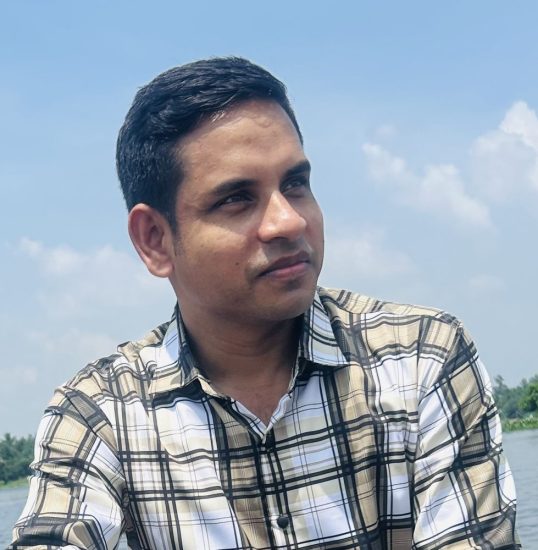

Kamol Karmakar
Assistant Professor
Qualification: B.A. (Honours), M.A. in English Language and Literature (ELL), M.A. in English Language Teaching (ELT)
Mobile: +8801886-135781
E-mail: kamolkarmakar6@gmail.com
- Short Biography
- Education
- Experiences
- Administrative Services
- Publications
- Grants
- Editorial Board/Reviewer
- Conferences
- Training
- Membership
- Awards and Achievements
Kamol Karmakar, an alumnus of the U.S. Department of State’s online OPEN Program, has been teaching in the Department of English at Gono Bishwabidyalay since December 22, 2024. He studied English at the undergraduate level and holds two Master’s degrees: a Master of Arts in English Language and Literature and a Master of Arts in English Language Teaching (ELT). By 2022, he had completed five Massive Open Online Courses (MOOCs) and a Global Online Course (GOC) offered by the OPEN Program.
Previously, he taught at several private universities in Bangladesh. His academic interests include American Literature and Culture, Modern South Asian Studies, and Teaching English in an EFL Setting. He is a Lifetime Member of the Bangladesh English Language Teachers’ Association (BELTA) and an Associate Member of the International Association of Teachers of English as a Foreign Language (IATEFL). He composes poetry, and his first poetry collection, Erotemes, was published by Worthy Publications in 2025.
Bachelor of Arts (Honours) in English — University of Information Technology and Sciences (UITS)
Master of English Language and Literature (MELL) — International Islamic University Chittagong (IIUC)
Master of Arts in English Language Teaching (MAELT) — International Islamic University Chittagong (IIUC)
1. Kamol Karmakar. “Tommy Wilhelm’s Psychological Rebirth in Saul Bellow’s Seize the Day: a Study from Jungian Perspective”. IOSR Journal of Humanities and Social Science (IOSR-JHSS), vol 25, no. 4, Apr. 2020, pp. 5-10.
2. Md. Azim Uddin, and Kamol Karmakar. “War-Love Dichotomy in A Farewell to Arms and Arms and the Man: A Comparative Study”. Journal of Noakhali Science and Technology University, vol. 4, no. 1-2, Jan. 2021, pp. 49-57.
3. Md. Mohib Ullah, Md. Eftekhar Uddin, Kamol Karmakar, Md. Saiful Alam, and Tauhidul Islam. “Exploring EFL Teachers’ Facilitating Critical Thinking Skills in Teaching Writing to Low-Proficient Undergraduate Students in Bangladesh: A Mixed Method Approach”. International Journal of English Language and Literature Studies, vol. 11, no. 4, Dec. 2022, pp. 222-234.
4. Kamol Karmakar. “The Scarlet Letter as a Fully-Realized Novel in Light of Forster’s Aspects of the Novel”. The Comilla University Journal of Arts, vol 7, June 2023, pp. 141-152.
5. Kamol Karmakar. “Relating the Meaning of Dickinson’s Select Poetry to the Social Realities of Bangladesh”. Mizoram University Journal of Literature and Cultural Studies (MZUJLCS), vol. XI, Dec. 2024, pp. 197-218.
6. Kamol Karmakar. “Understanding Bhuvaneshwari through the Kübler-Ross Model of Grief”. Literary Enigma, vol. 2, no. 5, Oct. 2025, pp. 1-6.
7. Kamol Karmakar, and Shabnaj Alam. “Uncovering the Semblance of Geography and Narrativity in Jaladas’ Jalaputra and Synge’s Riders to the Sea”. Journal of Gono Bishwabidyalay, vol. 6, Nov. 2025, pp. 137-146.
8. Book: Erotemes (Worthy Publications, 1st ed., 2025). ISBN: 978-984-98353-8-7.
1. Tommy Wilhelm’s Psychological Rebirth in Seize the Day (Webinar) — Organized by IQAC and URC, USTC; April 29, 2020 (Online).
2. A Date with Destiny (Debate Workshop) — Organized by the Department of English, USTC; October 5, 2020 (Online).
3. The Scarlet Letter as a Fully-realized Novel in Light of Forster’s Aspects of the Novel (Webinar) — Organized by the English Language and Culture Club, USTC; May 3, 2021 (Online).
4. Integrating Critical Thinking Skills into the Exploration of Culture in an EFL Setting (Cascading Session) — Organized by the English Language and Culture Club, USTC; June 7, 2021 (Online).
5. Imparting Critical Thinking Skills to the Undergraduate Writing Class in Bangladesh: Obstacles and Possibilities (Webinar) — Organized by the Department of English, USTC; July 12, 2021 (Online).
6. Academic Integrity at the University Level: Integrating Sources and Avoiding Plagiarism (Workshop) — Organized by the English Language and Culture Club, USTC; September 6, 2021 (Online).
7. Integrating Critical Thinking Skills into the Exploration of Culture in an EFL Setting (Cascading Session) — Jointly organized by OPEN, GASD, and BELTA Chittagong South; November 30, 2021 (Online).
8. Imparting Critical Thinking Skills to the Undergraduate Writing Class in Bangladesh: Obstacles and Possibilities (Seminar) — Organized by The Creative ELLSOC and the Department of English, UCTC; August 20, 2022 (In-person).
1. Research Methods, Tools and Techniques and Scientific Method of Report Writing — Institutional Quality Assurance Cell (IQAC), USTC | May 13–15, 2018
2. Teaching Pathways: How to Teach Pronunciation, British Council, Online (London, UK), March 1–19, 2022.
1. Bangladesh English Language Teachers’ Association (BELTA), Dhaka, Bangladesh — Lifetime Member (Membership ID: 2719), November 25, 2018–Present.
2. International Association of Teachers of English as a Foreign Language (IATEFL), Faversham, Kent, UK — Associate Member (Membership ID: 221699), September 15, 2021–Present.
1. Sonaichhari Union Parishad Scholarship — Awarded by Basantduta Club, Sonaichhari, Sitakund, Chattogram, November 4, 2002.
2. Kumira Foundation Scholarship — Awarded by Kumira Foundation, Kumira, Sitakund, Chattogram, December 25, 2002.
